For Everything Else There’s Mastercard: Anonymous and 21st Century Hacktivism
Gillian Terzis
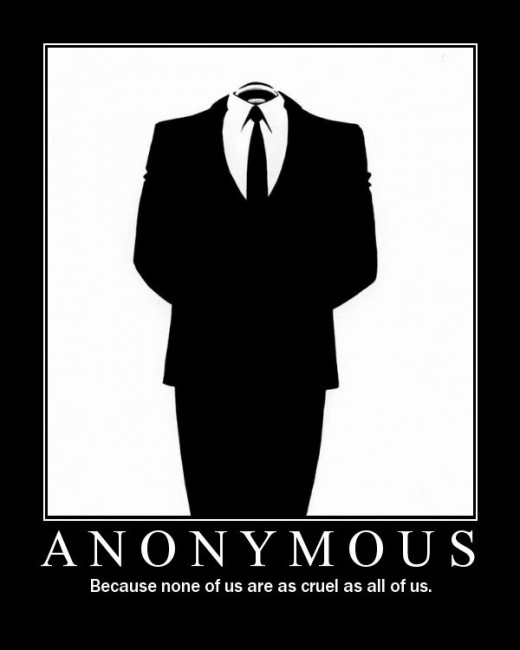

Recently Anonymous, a decentralised collective of hackers and activists, has been everywhere – getting headlines for crashing the websites of governments and corporations alike – but also nowhere. Like an insouciant wart on the foot of institutional power, Anonymous can be irritating, occasionally painful and primed for repeat visits. Their origins are similarly dubious. But we know that Anonymous is a loose coalition of members spawned from the swamps of 4chan: a cluster of bulletin boards where images are regularly uploaded, edited and re-edited by users, all of whom are anonymous. It is the Freudian Id on crack. It’s the place where memes – ideas in the form of a photo, video website, hashtag or phrase that evolve over time and are disseminated via the internet – are made, social mores are transgressed and brains are broken for the ‘lulz’. A corruption of LOL, lulz is the pure, unadulterated joy that comes from knowing that someone somewhere will be mortified by what you’ve uploaded. A hilarious post will unleash a torrent of replies, each one a show of brinkmanship. This is not unexpected: what is the point of social networking if not to constantly establish and re-establish one’s rank?
It was from this morass that Anonymous was spawned: an online community with no defined geographic centre and no formal command structure, although there are less than a handful of members who comprise the decision-making cabal. While Anonymous shares some similarities with 4chan – namely its focus on providing irreverent entertainment – it is increasingly associated with involvement in political and social movements. I wonder what is more astonishing: the fact that this army of trolls has transformed into a demimonde hacktivist movement, or that the movement has the capacity to redefine conventional models of activism.
As Anonymous does the majority of its protesting online, it’s assumed the majority of Anonymous supporters are teenagers and IT professionals with a lot of leisure time. Given the illegal nature of hacktivism, even my close Anon friends are unwilling to reveal too much. The reality is that anybody can count themselves among Anonymous’ rank-and-file, as long as you are in agreement with the objectives determined by the group’s hive mind.
I’ve found this hive mind mentality fascinating and repulsive in equal measure. In 4chan, it can generate fleeting cultural phenomena – Rickrolling, cat pictures, for example – and reveal a lot about human behaviour (casual perpetuations of homophobia and misogyny are rife). But in Anonymous, the group mentality mirrors that of real-life activist groups: it is politically idealistic but capable of being focused; its livelihood under siege from constant infighting. But there are some significant differences. For instance, hacktivism requires scant physical effort or genuine political engagement. It’s a bit like tweeting about Q&A.
That said, what intrigues me the most about Anonymous is how quickly the mood vacillates between anarchy and order. Enter the Anonymous internet relay chat channel and you can witness – in real time – the capacity of the hive mind to coalesce fruitfully. This tends to happen when Anons are planning a massive-scale DDoS attack distributed denial-of-service attacks. Often, there’s a lot of juvenile name-calling – but there have also been coups and counter-coups by Anons disenfranchised by the decision-making process. When disorder threatens to derail operations, members are reminded of the two unifying concepts that give Anonymous its potency: unwavering belief in the freedom of expression and the freedom to exchange information. In a world where decisions are routinely made on the basis of information and misinformation, where moral hazard cordons off the truly powerful from the rest of us saps, information is king.
But online, everyone in theory can be a commentator; no one is quite who they say they are and the rules are constantly in flux. It’s a virtual free-for-all for information. And that’s exactly how Anonymous wants it to stay. It’s as simple as wanting to ensure the freedoms we enjoy online are replicated in the real world.
Given Anonymous’ humble history, this explicitly political turn is all the more fascinating – and not necessarily a natural trajectory. Let us reconsider where Anonymous came from: 4chan, where 10.2 million visitors traverse its unwieldy terrain each month, where 550 posts per minute are uploaded without fear, favour or moderation – kiddie porn excepted. The most popular of the 4chan imageboards is /b/, the ‘random’ board where you’re likely to encounter puppies wearing wigs, a video of a man shafting a glass jar up his anus or nearnaked pictures of girls who veer precariously on the edge of legality. Every user is anonymous in 4chan, where there are no archives of posts, no accountability and no rules. There is, however, a guiding doctrine: ‘1. You do not talk about /b/. 2. You do not talk about /b/. 3. If it exists, there is porn about it. No exceptions.’
Only in these times could one forge a connection between forums for discussing spider rape and forums encouraging political activism, but these are strange times. Certainly, these parvenu origins are central to Anonymous’ modus operandi, where a culture of controlled anarchy and irreverence flourishes amid the group’s unique social structure, which resembles a sort of socialist utopia that Communist dictators would kill for. Quoth its somewhat mawkish manifesto: ‘Anonymous is a panopticon in reverse. A group where everyone is invisible and appears to speak from the center.’
Anonymous was previously renowned for its mockery of egregious displays of political correctness, hypocrisy and social conservatism. My interest in Anonymous was piqued by their trolling of Oprah last year, where the talk-show host – subsumed by a sensational fit of histrionics – informed the daytime sofa-set that a known paedophile network called Pedobear was raping children with ‘over 9,000 penises’. Before that, there was the group’s persistent targeting of the Church of Scientology over its status as a recognised, tax-exempt religion – where (DDoS) brought down Scientology websites – in addition to old-fashioned protesting outside Scientology headquarters. The protestors donned their Guy Fawkes masks, jived gamely to techno and brandished placards with six words bound to instil fear in those grappling with new technology: ‘DON’T WORRY, WE’RE FROM THE INTERNET.’
Nowadays, the group has sidelined its hallmark prankery in favour of pursuing explicitly political causes. So far, Anonymous has conducted DDoS attacks on the government websites of Tunisia, Egypt and Libya during their respective revolts against government repression; they attacked the website of Ireland’s main opposition party and they also defaced the official site of Zimbabwe’s government, after President Mugabe’s wife sued a newspaper for publishing a WikiLeaks report revealing her involvement in the illicit diamond trade.
Anonymous’ actions have briefly affected Australians, too. Closer to home, Federal Communications Minister Stephen Conroy was left to weather an Anonymous-driven deluge of pornographic emails, spam, black faxes and prank calls as part of Operation Titstorm on 10 February 2010. The operation was a rousing reveille for Anonymous loyalists to partake in a DDoS of Australian government servers in protest against the government’s mandatory internet-filtering legislation. The directive from Anonymous also specified that where possible, porn used in the attacks should feature small-breasted women, cartoon porn and female ejaculation – the three tropes that were frequently banned by the Australian Classification Board. Once again, the legitimacy of Anonymous’ actions was called into question – not only by the Australian Government but by anti-censorship groups in Australia. Nicholas Perkins, the co-founder of Stop Internet Censorship, believed Anonymous was inadvertently maiming the movement, telling the Sydney Morning Herald that ‘it would be much more helpful for [Anonymous] to put their efforts behind legitimate action’.
Indeed, Anonymous’ methodology continues to divide observers within and outside of the hacker community. DDoS attacks are useful for garnering media attention to certain political causes, but they can also be interpreted as an ironic attack on an opponent’s right to free speech. The persuasiveness of this argument depends on the size and character of Anonymous’ targets. Multinational corporations and governments may seem fair game, but what about the activities of private citizens? Are critics right to suggest Anonymous is eroding an already blurry distinction between public and private spheres?
Of course, similar criticisms were levelled at Wikileaks founder Julian Assange, who has been affectionately dubbed by Anonymous as ‘the most successful international troll of all time’. Assange has neither explicitly condemned nor endorsed Anonymous’ actions, but he did tell his supporters to uphold Wikileaks from the ‘instruments of US foreign policy’: PayPal, Mastercard and Visa. Anonymous showed their support by conducting Operation Payback, a string of DDoS attacks on those three companies, which Wikileaks needed to stay afloat. In any case, an article written by Assange in 2006 titled ‘The Curious Origins of Political Activism’ in Counterpunch – where he fondly recalls the anti-nuclear Worm Against Nuclear Killers (WANK) that penetrated NASA and Department of Energy servers in 1989 – suggests he would probably approve of Anonymous’ efforts to serve up politically-conscious hacking with a dash of irreverence.
Although the underlying ideologies behind Wikileaks and Anonymous are far from cogent, both outfits are primarily interested in the freedom of information and the exchange of that information; they both have the capacity to function as a check against abuses of institutional power. It’s an ethos which is fairly universal and grand in scope, and with a significant spike in Anonymous’ membership peaking in December last year (an additional 50,000 armchair activists, script kiddies and political agitators participated in bolstering Anonymous’ raison d’être), it appears to have struck a chord with disenfranchised online citizens all over the world.
In an era where taking to the streets has all but atrophied, one wonders if Anonymous’ brand of online activism signals an ineluctable trajectory for civil disobedience movements. Generally speaking, this is an organisation without a formal leadership structure that has channelled global forces of civil disobedience and achieved tangible outcomes. But the end-goal for Anonymous isn’t just to grind servers down to a stutter but to forcefully implement institutional change through cyber-intimidation and illegal acts. To do so, they’ll have to convince mainstream actors of their serious and genuine intentions.
For the most part, the media remains bewildered by Anonymous, not knowing quite what to make of the group’s mélange of illegal activity, political motivations and sardonic sense of humour. As the group does not visibly toil on any ideological coalface, mainstream media outlets have tended to portray Anonymous as a loose coalition of hackers with nebulous but sinister intent. Popular culture’s portrayal of The Hacker – a pasty, ungainly neckbeard with a penchant for massively multi-player online role-playing game (MMORPG) – seems predominant. As such, the brand of activism practised by Anonymous is still seen as something of a novelty. There are no bodies on streets or blood: nothing that makes for an easy, linear media narrative.
Electronic subterfuge is a comparatively bloodless pursuit; the scalps have been far and few between. (It is apt that Anonymous’ logo is a headless man in a tuxedo.) Nevertheless, authorities in the US and Europe are stepping up their game. A 16-year-old Dutch teenager was arrested for his involvement in Operation Payback, along with five other men from the UK. DDoS attacks have now been declared a major felony by the FBI, which has warned that Anonymous hackers could be liable for the maximum penalty of 10 years imprisonment.
Yet Anons are, for the most part, unfazed by the threat of incarceration. In an interview with the BBC, self-proclaimed spokesperson for the group, Coldblood, indicated that fellow Anons know that DDoS attacks are illegal but are compelled to participate if the cause is ‘worthy … and the possible outcome outweighs the risk’. Perhaps Anonymous’ intrinsic appeal is that it has the cachet of a select coterie of skilled-up script kiddies and internet activists, but is actually fairly accessible provided your politics – and your disdain for legality – are a good fit. Undoubtedly, the shield that anonymity affords its followers is probably a fundamental part of Anonymous’ appeal. Armchair activism is a relatively low-risk proposition. And yet one cannot help but think that the ‘smoke and mirror’ show surrounding Anonymous does it a disservice, particularly in the eyes of a sceptical mainstream audience. Rather than demystifying the call to activism, Anonymous’ mystique serves only to obscure it.
Funnily enough, things are most simplistic on the technology front. Anyone with moderate computer literacy can become Anonymous. Members of Anonymous partake in DDoS attacks by downloading an open source network attack application called Low Orbit Ion Cannon. Once downloaded, the application enrols your computer in a voluntary botnet, which culminates denial-of-service attacks from, say, tens of thousands of other users who have also installed the program on their computers. These attacks take a variety of forms: disruption of servers and routing information, consumption of bandwidth and so on. The result: they cause the website to crash. As far as methods of hacking go, DDoS is pretty primitive – but what it lacks in sophistication it makes up for in efficacy. Operation Payback crashed the Mastercard website for two days – just long enough to garner worldwide media attention and freak out corporate bigwigs.
Big business is certainly near the top of Anonymous’ hit list, in addition to governments – whether they are autocratic, democratic, left, centrist or right-wing. Given that Anonymous is a decentralized online community, it is probably unhelpful to pick a unifying political persuasion. As a member explained to the Baltimore City Paper: ‘We all have this agenda that we all agree on and we all coordinate and act, but all act independently toward it.’ A fairly anodyne description of the group’s politics, to say the least. Their brand of civil disobedience is a stark contrast to the centralised, ‘real-life’ social movements of the past, which generally had an identifiable leader and formal, hierarchical order. Theoretically, anyone can become a member, as long as they profess a loose identification with the group’s objectives. Coldblood, in conversation with the BBC, elaborated just how elastic this identification can be, suggesting that Anonymous is in fact an ‘online living consciousness, comprised of different individuals with, at times, coinciding ideals and goals’.
Indeed, a visit to Anonymous’ chat rooms reveals that these ‘coinciding ideals and goals’ emanate from a strong ‘hive mind’ mentality, which determines a sort-of order amidst the fractiousness. Anonymous members know each other by their pseudonyms, but are able to build relationships and trust over time in Internet Relay Chat conversations. To witness these IRC conversations is akin to experiencing the virtual unfolding of democracy, the way our Greek forebears intended it. Any member can suggest a target site. Vociferous debate often follows. And, much like any other real-life democracy, misinformation spreads swiftly. At any given time, 10 or so OPs can initiate DDoS attacks; if any OP is seen to be abusing his/her power, they are temporarily banned from the chat room. Abuses of power can occur when an OP tries to implement an attack that goes against the greater will of members, who can register their disapproval for a target site by pulling their computers out of the voluntary botnet. Numbers are crucial not only because they determine an attack’s effectiveness, but also its legitimacy.
After I wrote an article in The Atlantic about Anonymous’ evolution from pranksters to political activists, Andrew Naslund, a spokesperson from UnitedForIran.org, contacted me in a matter of minutes to express his views on whether one could justify Anonymous’ brand of hacktivism. UnitedForIran.org was given a lot of exposure by Anonymous, who were keen to promote the work of other online activists that focused on the protection of civil liberties. He says that although Anonymous ‘occasionally brings guns to the knife fight … their hearts usually have a good chance of being in the right spot – either intentionally or otherwise’. The group’s inclinations towards nasty retaliation may taint their legitimacy in the eyes of observers – not to mention the illegality of their actions – but it is increasingly difficult to dismiss them as the scalps accumulate. ‘I think Anonymous increasingly benefits from “momentum”,’ Naslund adds. ‘As they chalk up wins around the world, they seem more like a viable movement, and the more viable they seem, the more wins they chalk up.’
But the battle, of course, is far from over. DDoS attacks can be an effective form of registering dissent, but they are fairly provincial weaponry in today’s cyber war. Slate columnist Farhad Manjoo likened DDoS to a ‘Mean Girls-esque trick of having your friends prank-call your loser enemy all night long to tie up her phone’. Moreover, it’s unlikely that actual social and policy changes will be enacted as a result of Anonymous’ actions. Nevertheless, this shouldn’t diminish the genuine value of hacktivism to democracy – which lies in their capacity to call out gross misuses of institutional power.
It does seem like Wendell Phillips was onto something all those years ago, when he said the price of liberty was eternal vigilance. He was speaking in 1852 before the Massachusetts Antislavery Society, but his words retain their relevance. For now, it’s a cost those Anonymous brigadiers are willing to bear. After Operation Payback, the group took to Twitter and crowed mercilessly: ‘Freedom of expression is priceless. For everything else, there’s Mastercard.’
Share This Story


